
Why Brass and Bronze Change Colour: The Science of Patina, Corrosion & Surface Protection
From natural ageing and fingerprints to protective coatings and manufacturing controls, understanding how decorative metal surfaces behave is essential to designing finishes that perform as well as they look.
A brass chandelier can look flawless when it leaves the workshop and develop fingerprints, dark patches or uneven discolouration after installation. A bronze wall light may develop a rich brown surface over time, while another fixture in the same building develops powdery green deposits around its joints.
These are not necessarily the same problem.
Some colour changes are natural and expected. Others indicate contamination, coating failure or corrosion. The difference depends on the alloy, surface preparation, finish system, environmental exposure and quality of manufacturing.
For designers, the challenge is to specify the intended appearance and its expected behaviour. For procurement teams, it is to verify that the supplier can deliver that specification. For manufacturers, it is to control the material and finishing processes that determine the final result.
This article examines the science behind these changes and, more importantly, the engineering measures used to manage them.
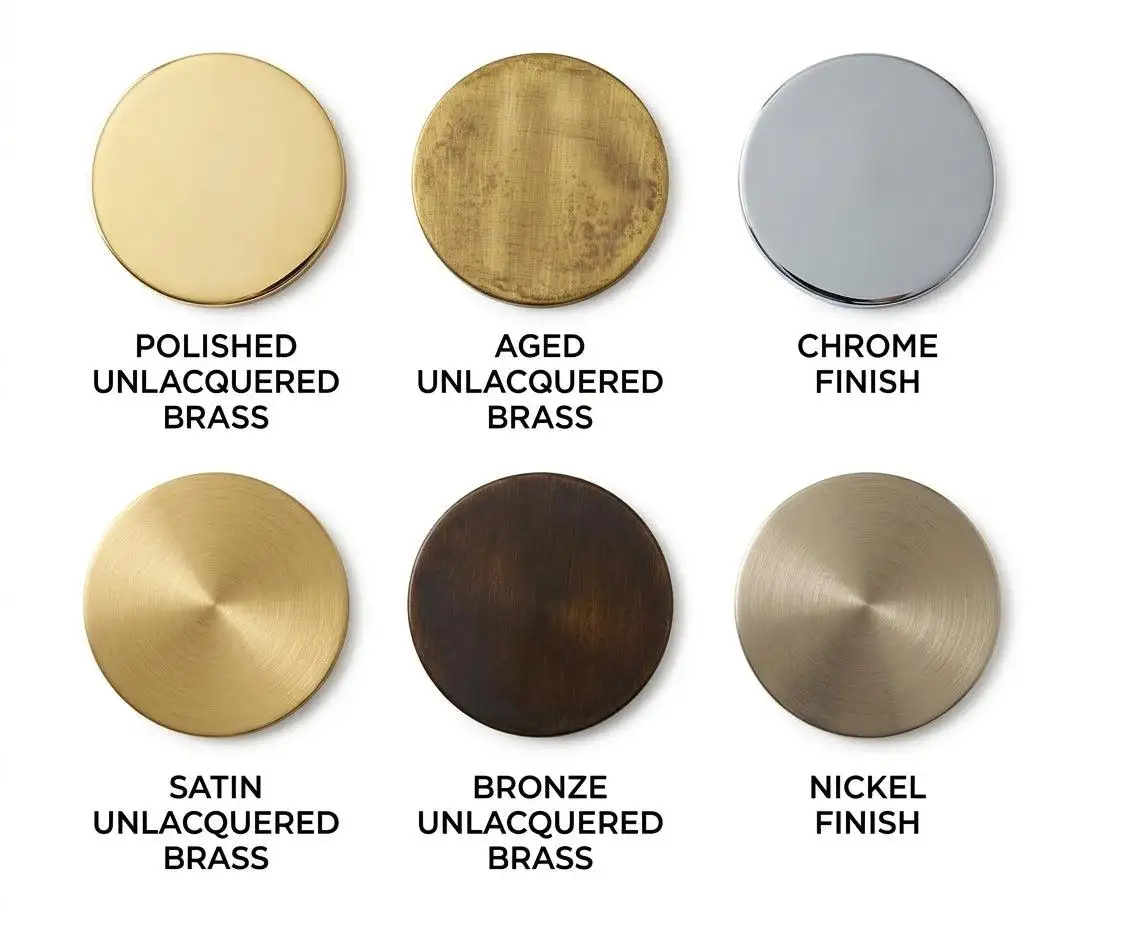
1. First, understand what is actually on the surface
Brass and bronze are copper-based alloys, but their appearance is not determined by the alloy alone.
A decorative metal component may have several distinct layers or treatments:
- Base metal: Brass, bronze or another copper alloy.
- Mechanical finish: Polished, brushed, satin, hammered or textured.
- Chemical treatment: A patina or other chemically developed surface colour.
- Deposited finish: Electroplating, PVD or another applied metallic coating.
- Protective layer: Clear lacquer, conversion coating, wax or another protective system.
These layers perform different functions. A polished brass component with a clear lacquer is not equivalent to bare polished brass. A chemically patinated bronze with a protective topcoat is not equivalent to untreated bronze.
The first requirement in any technical specification is therefore to identify the actual substrate and finish system, rather than simply stating a colour such as antique brass, brushed bronze or champagne gold.
2. Why brass and bronze change colour
Natural oxidation and tarnishing
Copper alloys react with their surroundings. Exposure to oxygen, moisture and atmospheric contaminants gradually changes the surface chemistry.
The resulting surface layer may appear darker, browner, reddish, black or greenish, depending on the alloy and exposure conditions.
This process is often described as oxidation or tarnishing, although the actual corrosion products can involve several different chemical compounds.
A thin, stable and adherent surface layer may be an acceptable part of the intended appearance. It is not automatically evidence of a defective product.
Engineering response
The first decision is whether the design should permit natural ageing or retain a relatively consistent original appearance.
For a naturally ageing finish:
- Select an alloy and surface treatment compatible with the intended patina.
- Approve a representative aged sample, not just a freshly finished sample.
- Define acceptable colour variation.
- Provide maintenance guidance that does not require repeated polishing.
For a finish intended to retain its appearance:
- Specify a compatible protective coating or deposited finish.
- Define the expected service environment.
- Require coating-process documentation and relevant performance tests.
- Establish an inspection and maintenance regime.
A finish cannot be selected independently of the environment in which it will operate.
Natural patina versus intentional chemical patina
A natural patina develops gradually through exposure. An intentional patina is produced through controlled chemical treatment during manufacturing.
Manufacturers may use chemical solutions, controlled application techniques and subsequent surface finishing to create brown, black, green or other decorative effects.
The final appearance depends on the alloy composition, surface preparation, chemical concentration, application time, temperature, rinsing and finishing process.
Engineering response
A chemical patina should be treated as a controlled manufacturing operation, not an informal colour treatment.
Manufacturers should:
- Confirm the alloy and its compatibility with the patination process.
- Standardise cleaning and surface preparation.
- Control the chemical treatment and application time.
- Rinse and neutralise where required by the process.
- Dry the component thoroughly.
- Apply a compatible protective finish when the design requires it.
- Record the process parameters and approve a physical reference sample.
Designers should specify whether the patina is intended to remain exposed, receive a wax treatment or be sealed with a clear protective coating.
The coating can change colour depth, gloss and visual character. It must therefore be approved as part of the complete finish, not as an invisible afterthought.
Dezincification: When brass loses zinc
Brass contains copper and zinc. Under certain environmental and chemical conditions, zinc can be selectively removed from the alloy. This process is known as dezincification.
The affected area may become pink or reddish because the remaining surface is enriched in copper. The metal can also become porous and lose mechanical integrity.
This is more than a cosmetic issue when it affects components carrying loads, supporting a fixture or forming a critical connection.
Engineering response
- Select an appropriate brass alloy for the intended environment and application.
- Avoid exposing susceptible brass to unsuitable acidic or alkaline cleaning chemicals.
- Consider dezincification-resistant brass where the application and exposure justify it.
- Specify material identification and traceability for critical components.
- Investigate unexplained pink areas, especially where the component has a structural or mechanical function.
A decorative finish must never be used to conceal an unsuitable base material.
3. Fingerprints: A small contact that can leave a permanent mark
Fingerprints are particularly visible on polished brass, bronze and other reflective metal finishes.
The reason is not simply that fingers leave grease. Perspiration contains moisture and dissolved salts, while skin oils contain organic compounds. These residues remain on the metal after handling.
In the presence of moisture and atmospheric contaminants, they can produce localised surface reactions. On some finishes, the mark can become difficult to remove without disturbing the original surface.
The risk is higher on frequently handled components such as:
- Decorative door and cabinet hardware.
- Table lamps and portable lighting.
- Accessible sections of wall lights.
- Chandelier arms and exposed decorative details during installation.
- Fixtures in hospitality environments where housekeeping teams regularly handle them.
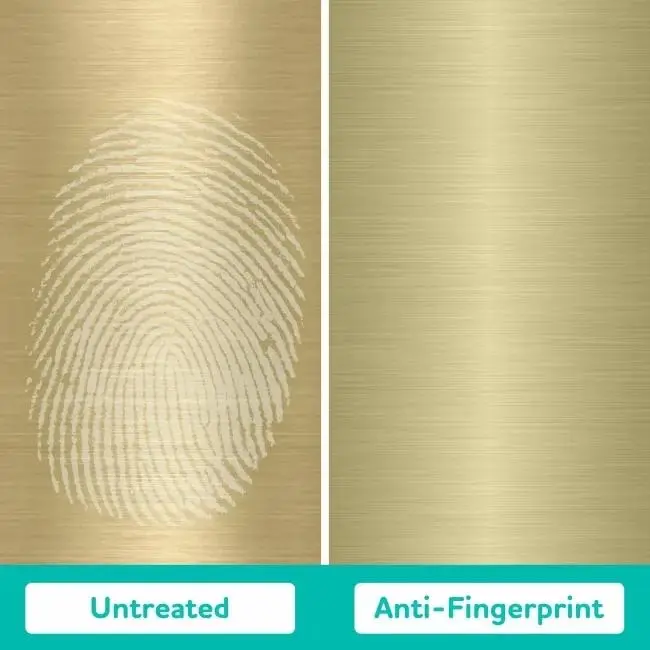
What does fingerprint-resistant actually mean?
A fingerprint-resistant finish is designed to reduce the visibility or adhesion of fingerprints, or make them easier to remove.
It does not mean that fingerprints cannot occur under any circumstances.
There are several engineering approaches.
1. Surface texture and reflectivity
A carefully selected satin, brushed or textured finish may make fingerprints less visually obvious than a mirror-polished surface.
This is partly an optical effect. The mark may be less visible even if some residue remains.
2. Clear protective coatings
A compatible clear lacquer or protective coating can isolate the base metal from direct contact with skin residues.
Performance depends on coating chemistry, film continuity, adhesion, thickness, curing and resistance to cleaning agents.
3. Specialised anti-fingerprint coatings
Some coating systems are formulated to reduce fingerprint visibility, improve cleanability or reduce the adhesion of oils and residues.
Their suitability must be established for the actual substrate, finish and operating environment.
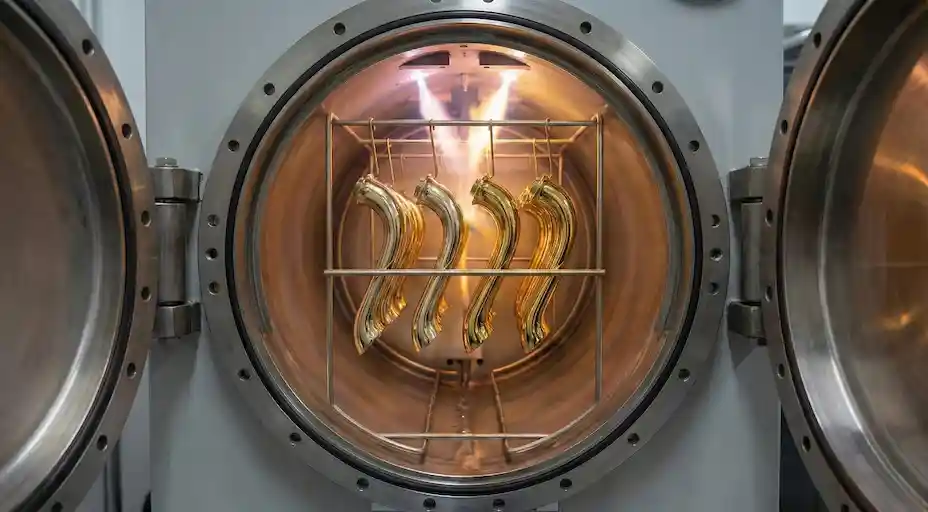
4. PVD and deposited finishes
Physical Vapour Deposition can provide a thin, hard decorative coating with useful wear and surface-performance characteristics.
However, PVD is not automatically fingerprint-proof. Its performance depends on the coating composition, substrate preparation, coating architecture, surface texture and the presence of defects or exposed areas.
A PVD-coated brass component may still show fingerprints, particularly if the final surface is highly reflective.
What the manufacturer should do
A manufacturer receiving a fingerprint-resistant requirement should not simply select a finish from a colour chart.
The manufacturer should:
- Clarify whether the requirement is reduced visibility, easier cleaning or reduced chemical interaction.
- Confirm the substrate and surface preparation.
- Select a compatible coating system.
- Ensure consistent coating coverage across the component.
- Validate the finish using representative handling and cleaning tests.
- Submit samples for approval under realistic lighting conditions.
For high-contact components, a fingerprint-resistance requirement should be tested on the actual production finish, not inferred from the coating manufacturer's general product description.
4. Dust resistance: Why surface design matters
Dust is not a corrosion mechanism in itself, but accumulated dust can affect the appearance and maintenance of decorative metalwork.
Dust may contain mineral particles, salts, fibres and other contaminants. In humid conditions, some deposits can retain moisture against the surface.
On polished finishes, wiping dust away with a dry or unsuitable cloth can also create fine scratches.
The design of the fixture is often as important as the finish.
Consider a chandelier with:
- Narrow decorative grooves.
- Overlapping metal plates.
- Open-ended tubes.
- Complex cast details.
- Horizontal ledges.
- Inaccessible joints.
These features can collect dust and make routine cleaning difficult.
Engineering measures for dust management
For designers
- Avoid unnecessary dust-trapping recesses where practical.
- Consider accessible surfaces and cleaning clearances.
- Minimise inaccessible horizontal ledges.
- Coordinate the fixture design with the hotel's maintenance access and cleaning procedures.
For manufacturers
- Remove burrs and sharp edges that trap fibres.
- Avoid unintended gaps and poorly finished joints.
- Ensure accessible assembly and service points.
- Use surface finishes that tolerate the agreed cleaning method.
For procurement teams
- Request maintenance and cleaning instructions.
- Evaluate a representative assembled sample.
- Consider the cleaning access required for the fixture's actual installation height and geometry.
A smooth coating may improve cleanability, but it does not make a complicated fixture dust-proof.
For this reason, the more useful specification is often easy to clean and maintain, supported by design and finish requirements.
5. Humidity, condensation and temperature
Moisture is one of the most important contributors to metal corrosion.
High relative humidity increases the likelihood of a thin moisture film forming on surfaces. Condensation can occur when the metal surface temperature falls below the surrounding air's dew point.
This can happen near air-conditioning outlets, poorly ventilated ceilings, exterior-facing walls and other areas with changing temperature conditions.
Humidity becomes especially important when salts or other contaminants are already present.
Engineering response
- Identify whether the fixture is intended for a dry interior, humid interior, bathroom, coastal property or semi-exposed location.
- Select the alloy and protective finish accordingly.
- Protect joints, cut edges and concealed surfaces.
- Avoid water-retaining geometries and unsealed crevices where practical.
- Check whether the coating system is suitable for the actual exposure.
- Include environmental conditions in the finish approval process.
A coating that performs well in a dry hotel lobby may not perform equally well in a coastal resort or a bathroom environment.
6. Sulphur compounds, chlorides and chemical exposure
Atmospheric pollutants can react with copper alloys and alter their appearance.
Sulphur-containing compounds can contribute to dark tarnish. Chlorides, including those carried in sea-salt aerosols or fingerprints, can accelerate corrosion when moisture is present.
Other sources of contamination include:
- Cleaning chemicals and disinfectants.
- Acidic or alkaline cleaning solutions.
- Residues from polishing compounds.
- Contact with unsuitable oils, waxes or rubber materials.
- Construction dust and airborne contaminants.
Marine and coastal environments
Coastal projects require particular attention because airborne salt can settle on exposed surfaces.
The combination of chlorides and moisture can create conditions for localised corrosion, particularly where protective coatings are damaged or discontinuous.
Engineering response
For coastal and high-exposure projects:
- Assess the actual exposure rather than relying on the description "indoor use".
- Select suitable alloys and coating systems.
- Pay attention to joints, edges, fasteners and concealed areas.
- Specify cleaning frequency based on exposure.
- Validate the complete finish system using appropriate corrosion testing.
A salt-spray test can be useful for evaluating a coating system under defined conditions. It should not be treated as a direct prediction of years of service in a real building.
7. Protective finishes: What each system actually does
There is no universal finish that provides the best appearance, fingerprint resistance, corrosion protection, durability and repairability simultaneously.
The correct system depends on the design intent and operating conditions.
Clear lacquer
A transparent lacquer can protect the underlying metal from direct contact and slow tarnishing.
Its performance depends on:
- Surface cleanliness before application.
- Compatibility with the substrate and any patina.
- Adhesion and coating continuity.
- Film thickness and uniformity.
- Curing conditions.
- Resistance to expected cleaning chemicals and handling.
Lacquer can deteriorate through abrasion, chemical exposure, ageing or localised damage. Once the protective layer becomes discontinuous, the underlying metal may develop uneven discolouration.
Wax
Wax can provide a sacrificial protective layer and alter the surface sheen.
It is useful in certain maintenance and conservation applications, particularly on patinated bronze. It generally requires periodic renewal and should not be treated as a permanent coating.
Wax is not a substitute for a properly engineered coating system where higher chemical, abrasion or environmental resistance is required.
Electroplating
Electroplating deposits a metallic layer onto the substrate through an electrochemical process.
The final performance depends on the deposited metal, layer thickness, underlayers, surface preparation, porosity and adhesion.
A decorative plated finish should be specified as a complete coating system, not merely by its visible colour.
PVD (Physical Vapour Deposition)
PVD is a vacuum deposition process used to apply thin functional and decorative coatings.
Depending on the coating material and process, PVD can provide:
- Improved surface hardness.
- Wear resistance.
- A range of decorative colours.
- Useful corrosion performance when correctly engineered.
However, the coating is thin, and its performance depends on substrate preparation, coating architecture, defects, edges and the underlying material.
PVD should not be specified as a universal solution to fingerprints, dust or corrosion.
Comparison of finish strategies
| Finish system | Main advantage | Important limitation |
|---|---|---|
| Natural brass or bronze | Authentic material character and natural ageing | Appearance changes with exposure |
| Chemical patina | Controlled decorative colour | Requires process consistency and may need protection |
| Clear lacquer | Helps preserve the underlying appearance | Can wear, scratch or fail locally |
| Wax | Simple sacrificial protection | Requires periodic renewal |
| Electroplating | Metallic decorative finish | Depends on underlayers, thickness and process control |
| PVD | Hard, thin decorative coating with useful wear properties | Does not guarantee fingerprint-free or defect-free performance |
The specification should identify the complete finish build-up, including the substrate, preparation, treatment, coating and final appearance.
8. Manufacturing controls: Where finish performance is won or lost
A high-quality finish is not created by the final coating operation alone.
It depends on the entire production sequence.
Step 1: Material selection and verification
The manufacturer should confirm the base alloy and ensure it is suitable for the intended application.
Where performance is critical, material certificates or appropriate material verification should be requested.
The visible colour of a metal is not proof of its alloy composition.
Step 2: Surface preparation
Before any coating or chemical treatment, the surface must be prepared consistently.
This may include:
- Removal of machining residues.
- Deburring and edge preparation.
- Mechanical polishing or brushing.
- Degreasing.
- Removal of polishing compounds.
- Controlled cleaning and drying.
Contamination left on the surface can interfere with adhesion and produce visible defects.
Step 3: Controlled treatment
Chemical patination, plating and PVD require process controls appropriate to the selected system.
The manufacturer should follow the coating supplier's process requirements and record relevant parameters.
Step 4: Coating application
The coating must be suitable for the substrate, finish and operating environment.
The manufacturer should control:
- Application conditions.
- Coating thickness where applicable.
- Coverage and continuity.
- Edge and recess protection.
- Curing and drying.
- Handling after finishing.
Complex decorative fixtures require particular attention because recessed areas and assembled joints can be difficult to coat uniformly.
Step 5: Inspection and production consistency
The first approved sample should become the production reference.
Manufacturers should compare production batches against agreed criteria for:
- Colour and shade.
- Gloss and reflectivity.
- Surface texture.
- Visible coating defects.
- Adhesion and continuity.
- Fit and finish at joints and connections.
A sample that looks correct under one lighting condition may appear very different under warm hotel lighting or daylight. Finish approval should consider the actual project environment.
9. Testing: How should performance be verified?
Terms such as durable, anti-tarnish, fingerprint-resistant and corrosion-resistant are not meaningful unless they are connected to measurable requirements.
Testing should be selected according to the expected failure mechanism.
| Requirement | Possible verification method | What it helps evaluate |
|---|---|---|
| Coating adhesion | ASTM D3359 or ISO 2409, where applicable | Resistance to coating separation |
| Abrasion resistance | ASTM D4060 for applicable organic coatings | Wear under defined abrasion conditions |
| Salt exposure | ISO 9227 | Behaviour under a controlled salt-spray environment |
| Artificial perspiration | ISO 3160-2, where applicable to the coating and product | Resistance to defined perspiration exposure |
| Humidity resistance | An agreed damp-heat or humidity test | Behaviour under controlled moisture exposure |
| Chemical resistance | Exposure to specified cleaning agents | Compatibility with actual maintenance chemicals |
| Fingerprint resistance | Agreed fingerprint application, dwell and cleaning procedure | Mark visibility and cleanability |
| Appearance consistency | Agreed colour, gloss and visual inspection criteria | Batch-to-batch finish consistency |
Not every test is suitable for every product. The test method, substrate, coating system, exposure duration, evaluation criteria and acceptance limits must be agreed in advance.
For example, passing a salt-spray test does not automatically establish a particular number of years of service in a coastal hotel. Accelerated testing is useful for comparison and quality control, but it does not perfectly reproduce every real-world exposure.
For decorative lighting, the finished component should be tested wherever practical, including representative edges, joints and assembled areas.
10. What designers and procurement teams should specify
The most common specification problem is the use of broad finish descriptions without defining the required performance.
"Antique brass", "fingerprint-free gold", "dust-resistant bronze" and "anti-corrosion finish" do not, by themselves, establish a manufacturing specification.
A useful finish schedule should answer the following questions.
Material and appearance
- What is the actual base metal and alloy?
- Is the finish polished, brushed, satin, textured or patinated?
- Is the colour intended to remain consistent or age naturally?
- What level of colour and gloss variation is acceptable?
Environmental exposure
- Is the fixture in a dry interior, humid interior, bathroom or coastal location?
- Will it be frequently handled?
- Will it be exposed to cleaning chemicals or disinfectants?
- Is it near an air-conditioning outlet or a condensation-prone area?
Performance
- Is fingerprint visibility a concern, or is easy cleaning the actual requirement?
- Is corrosion resistance required for a particular exposure?
- What level of abrasion or wear is expected?
- Does the finish need to retain its colour and gloss over time?
Manufacturing and quality control
- What is the complete finish system?
- What surface preparation is required?
- What tests and acceptance criteria apply?
- Is a physical production sample required?
- How will the manufacturer maintain consistency across batches?
Maintenance
- Which cleaning agents are approved?
- Which cleaning methods must be avoided?
- Is periodic coating renewal expected?
- Can the finish be repaired locally, or does it require complete refinishing?
A clear specification reduces ambiguity between the designer, buyer and manufacturer. It also makes quotations more comparable because suppliers are being asked to deliver the same performance rather than interpret the same colour description differently.
11. A practical finish-selection framework
The following framework can be used when developing a decorative lighting specification.
If the design requires natural ageing: Select an appropriate alloy and patination strategy. Define the expected ageing character and acceptable variation.
If the design requires a consistent polished appearance: Evaluate a compatible clear protective coating or deposited finish. Confirm its resistance to the expected cleaning and handling conditions.
If the fixture will be frequently handled: Specify fingerprint visibility and cleanability separately. Approve a representative sample and establish a practical test procedure.
If the project is coastal or highly humid: Assess alloy suitability, coating continuity, edge protection, joints and environmental testing.
If the fixture has complex geometry: Review cleaning access, coating coverage and the potential for dust or moisture accumulation before finalising the design.
If the fixture is difficult to replace or access: Give greater attention to maintainability, repairability, finish documentation and the availability of replacement components.
The most expensive finish is not necessarily the most appropriate. The best solution is the one that meets the design intent and operating requirements without creating unnecessary maintenance or replacement costs.
12. The Maven perspective: Finish engineering begins before manufacturing
At Maven Decoratives, decorative lighting development involves more than selecting a fixture shape and matching a metal colour.
The material, surface treatment, coating system, manufacturing process and installation environment must be considered together.
A brass finish intended for a frequently handled table lamp has different requirements from a patinated bronze chandelier suspended in a double-height hotel lobby. A coastal resort requires a different exposure assessment from a dry residential interior.
For this reason, finish development should begin with a clear project brief:
- What material is being used?
- What appearance is intended?
- How will the surface age?
- What environmental conditions will it encounter?
- How frequently will it be handled or cleaned?
- What manufacturing controls are required?
- How will the finished product be inspected and maintained?
The objective is not to promise that metal will never change colour, collect dust or show fingerprints. The objective is to understand those risks, select an appropriate system and control the manufacturing variables that influence long-term performance.
A decorative metal finish should be judged not only by how it looks on the day of delivery, but by how appropriately it performs throughout the life of the installation.
Technical references and further reading
-
Canadian Conservation Institute, The Cleaning, Polishing and Protective Waxing of Brass and Copper.
-
Canadian Conservation Institute, Basic Care: Recognizing Metals and Their Corrosion Products.
-
Canadian Conservation Institute, Preventing and Treating the Dezincification of Brass.
-
Canadian Conservation Institute, Caring for Metal Objects: Preventive Conservation Guidelines.
-
International Organization for Standardization, ISO 9227:2022 — Corrosion Tests in Artificial Atmospheres: Salt Spray Tests.
-
International Organization for Standardization, ISO 2409 — Paints and Varnishes: Cross-Cut Test.
Technical note: Standards should be checked for their current edition, scope and applicability to the specific substrate and finished product before being included in a contractual specification.