
Before You Polish That Brass: A Hotel Engineer's Guide to Tarnish, Patina & Corrosion
A brass wall lamp looked golden when it was installed fifteen years ago. Today, it has dark patches around the edges, fingerprints near the switches, green marks around a joint and a few areas where the surface looks dull or cloudy.
Should the maintenance team polish it? Clean it with a metal cleaner? Apply lacquer? Or leave the surface alone?
The answer depends on what has happened to the metal.
A decorative lighting fixture can develop ordinary dust, fingerprints, natural tarnish, an intentional patina, damaged lacquer or active corrosion. These problems can look similar at first, but they do not have the same causes or require the same treatment.
For hotel engineering teams, housekeeping supervisors and facilities managers, the first rule is simple:
Do not start polishing until you know what surface you are dealing with.
Repeated polishing can remove metal, soften decorative details and change the original appearance. An abrasive cleaner that improves one uncoated brass component can permanently damage a lacquered or plated fixture.
This guide explains what to look for, what causes the problem, what maintenance can safely do and when a specialist is needed.
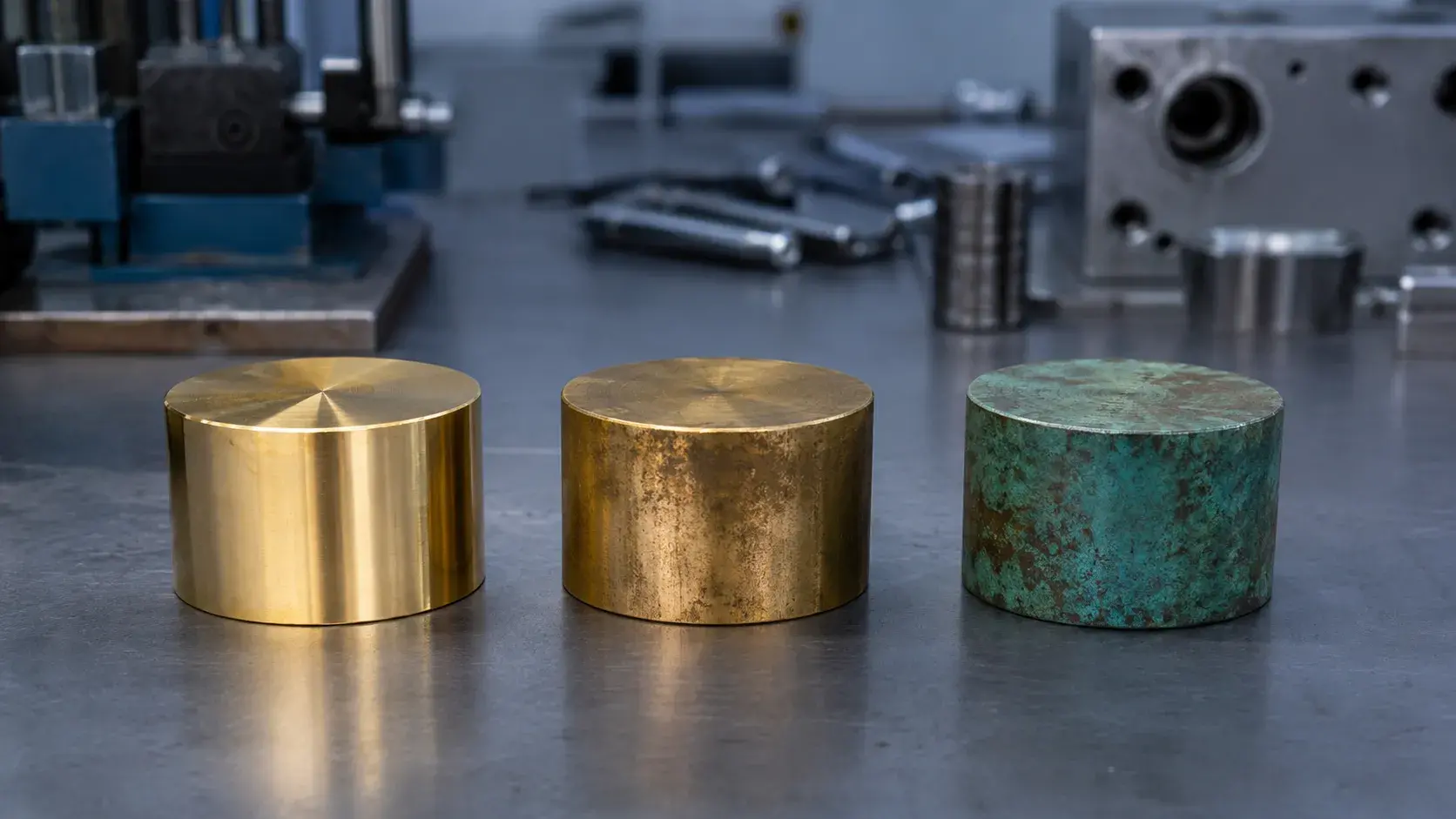
1. First identify the surface
Before choosing a cleaning method, establish whether the fixture is made from solid brass, another copper alloy, plated metal or a coated substrate.
The visible golden colour does not prove that the underlying material is brass. Many decorative fixtures have a brass-coloured plating or a transparent protective lacquer.
If the original manufacturer, finish schedule or maintenance instructions are available, consult them first. If the surface is unknown, treat it as a potentially coated finish until assessed.
A simple inspection should establish:
- Whether the finish is glossy, brushed, matte, darkened or intentionally patinated.
- Whether the colour is uniform or changing in isolated patches.
- Whether there are fingerprints, dust, greasy deposits, green powder, blisters or peeling.
- Whether the problem is concentrated near joints, fasteners, exposed edges or frequently touched areas.
- Whether the fixture is exposed to coastal air, cleaning chemicals, high humidity or kitchen exhaust.
Photograph the affected areas before cleaning. Record the location and severity so that changes can be compared during later inspections.
2. Five different problems that should not be confused
A. Dust, fingerprints and skin oils
What you see: Dust on upward-facing surfaces, greasy marks, fingerprints and uneven smudges around frequently touched areas.
Why it happens: Dust settles on horizontal surfaces, ledges and intricate decorative details. Skin oils and perspiration leave residues that change how light reflects from polished metal. Those residues can also contribute to local surface reactions.
What to do: Begin with gentle dry dusting using a clean, soft, non-abrasive cloth. For fingerprints, use only a cleaning method approved for the known finish. Do not assume that a damp cloth or detergent is safe for every coating.
Avoid repeatedly rubbing the same spot with pressure. That can create a polished patch or scratch a softer coating.
For chandeliers, work only after the fixture has been safely isolated from electrical power and any hot components have cooled. Cleaning must not introduce liquid into sockets, drivers, wiring or electrical connections.
B. Natural tarnish and oxidation
What you see: Gradual darkening, a warmer brown tone, loss of brightness or a change from a fresh yellow-gold colour to a more subdued appearance.
Why it happens: Copper and its alloys react with substances in their environment. Oxygen, moisture and airborne pollutants, including sulphur-containing compounds, can contribute to surface changes.
These changes do not automatically mean that the metal is failing. A stable, adherent surface layer may be part of the metal's natural ageing.
What to do: First decide whether the original finish was intended to remain bright or to age naturally. If the surface is stable and the darker appearance is acceptable, gentle cleaning and routine monitoring may be all that is required.
Do not automatically remove the tarnish. If the original design requires a bright finish, restoration should follow a method compatible with the actual substrate and coating.
C. Intentional chemical patina
What you see: A deliberately darkened, brown, black or otherwise coloured surface, sometimes with variation between raised details and recessed areas.
Why it happens: Manufacturers and finish specialists can apply chemical treatments to create an aged appearance. The treatment may form a surface layer that is subsequently sealed or protected.
What to do: Preserve the intended appearance. Use the manufacturer's specified cleaning method and avoid abrasive polishing unless restoration of the finish has been explicitly approved.
Removing a patina can erase the contrast between raised and recessed details. Recreating the original finish may require specialist surface preparation and controlled reapplication.
A dark surface is not, by itself, proof of corrosion or damage.
D. Lacquer failure or coating damage
What you see: Cloudy patches, peeling, blisters, scratches, localised colour differences or dark marks beneath a transparent surface.
Why it happens: Protective coatings can deteriorate with age, abrasion, chemical exposure, poor adhesion or damage at edges and joints. Cleaning solvents may soften or attack some coatings.
When a coating becomes discontinuous, exposed areas may age differently from protected areas. The result can be patchy, difficult-to-reverse discolouration.
What to do: Do not attempt to correct the problem by polishing the entire fixture. Polishing may remove some coating, leave other areas intact and make the appearance less uniform.
Document the affected area and obtain a finish-restoration assessment. Depending on the fixture, restoration may involve controlled coating removal, surface preparation and reapplication of a compatible protective system.
E. Active corrosion
What you see: New or spreading powdery deposits, recurring green or blue-green spots, loose surface material, local deterioration around joints or changes that continue after ordinary cleaning.
Why it happens: Moisture, salts, unsuitable cleaning residues and environmental contamination can contribute to corrosion. On susceptible brass, dezincification selectively removes zinc and can leave a weakened, copper-rich surface.
Some corrosion products are stable. Others indicate ongoing deterioration. Colour alone cannot reliably distinguish them.
What to do: Stop routine polishing and record the affected area. If the corrosion is powdery, spreading or associated with material loss, refer it to a qualified metal conservator or suitable restoration specialist.
Do not scrape away deposits, apply acid or use an aggressive metal polish to make the surface look clean. If a component is structurally weakened or a suspension connection is affected, the fixture must be assessed before it is returned to service.
The Canadian Conservation Institute provides useful guidance on recognising active corrosion.
3. What causes brass and copper alloys to deteriorate?
Understanding the source of a problem helps prevent it from returning.
| Exposure or cause | What it can do | Maintenance response |
|---|---|---|
| Dust and handling | Leaves deposits, fingerprints and uneven appearance | Gentle routine dusting and reduced direct handling |
| Skin oils and perspiration | Causes marks and can contribute to local reactions | Clean promptly using the approved method for the finish |
| Humidity and condensation | Encourages surface reactions and can aggravate existing coating defects | Investigate persistent moisture and improve environmental control where practical |
| Sulphur-containing airborne pollutants | Can darken copper and its alloys | Reduce pollutant sources where feasible and follow a compatible maintenance plan |
| Chlorides and salt deposits | Can contribute to corrosion, particularly in humid or marine environments | Remove deposits using a finish-compatible method and investigate recurring exposure |
| Acidic or alkaline cleaners | May attack susceptible alloys or finishes | Stop unapproved products and use manufacturer-approved cleaning instructions |
| Abrasive polish and metal wool | Scratches surfaces and removes metal or coatings | Avoid unless a specific restoration procedure authorises their use |
| Residual polish in crevices | Can leave deposits and cause local staining | Prevent excess application and ensure the approved method removes residues |
| Damaged or aged lacquer | Allows uneven exposure of the substrate | Assess coating condition and arrange appropriate restoration |
The Canadian Conservation Institute notes that fingerprints, dust, grease and polish residues can contribute to deterioration. It also warns that acids and alkaline solutions can cause dezincification in susceptible brass, and that polish residues can produce green-blue compounds.
Reference: Cleaning, Polishing and Protective Waxing of Brass and Copper.
4. Why hotel lighting needs a different maintenance approach
Decorative lighting in hospitality spaces faces a combination of appearance expectations, frequent cleaning, handling, operating heat and difficult access.
A chandelier in a lobby may accumulate dust on upper surfaces and around decorative joints. A brass bedside lamp may show fingerprints around its controls. A wall sconce near a coastal entrance may be exposed to humid, salt-laden air. A fixture near a kitchen or exhaust outlet may experience a different mixture of airborne deposits.
These are different maintenance conditions. They should not be addressed with one universal polishing schedule.
A practical maintenance plan should record:
- Fixture location and accessibility.
- Known base metal and finish, if available.
- Areas of frequent handling or visible deposits.
- Environmental exposure, including moisture and salt.
- Approved cleaning products and methods.
- Previous restoration, coating or polishing work.
- The condition of electrical components, mounting points and suspension hardware.
Cleaning and electrical inspection are separate tasks. A fixture that looks clean is not necessarily electrically or mechanically safe.
5. A safe maintenance procedure for an older brass lamp
For a fifteen-year-old lamp with an unknown finish, use the following sequence.
Step 1: Isolate and inspect. Switch off and safely isolate the electrical supply. Allow the fixture to cool. Inspect the metal, coating, wiring, lamp holder and visible connections without dismantling components unnecessarily.
Step 2: Photograph the condition. Record tarnish, fingerprints, scratches, coating defects and any powdery deposits. This creates a baseline for comparison.
Step 3: Remove loose dust gently. Use a clean, soft cloth or a suitable soft brush. Do not use abrasive pads, steel wool or aggressive polishing compounds.
Step 4: Identify the finish. Consult maintenance records, the manufacturer or a qualified specialist. If the finish is unknown, do not use metal polish, solvents, acids or alkaline cleaners as an experiment.
Step 5: Test only an approved method. If the finish and cleaning method are known, test the method on a discreet area and check for colour transfer, clouding, scratches or other changes. Follow the manufacturer's instructions.
Step 6: Stop if the surface changes unexpectedly. Peeling, recurring green deposits, powdery corrosion, exposed substrate or rapidly changing colour requires assessment rather than more aggressive cleaning.
Step 7: Record and review. Note the method used, products applied and resulting condition. Recurring problems may indicate a coating defect or an environmental cause that routine cleaning cannot solve.
For chandeliers and large suspended fixtures, access equipment, isolation, dismantling and reinstatement should be handled by competent personnel under the property's safety procedures.
6. What should manufacturers do to prevent these problems?
Maintenance does not begin when a fixture becomes dirty. It begins during material selection, finishing, assembly and handover.
A well-coordinated specification should address the following.
Specify the actual substrate
Record whether the component is solid brass, bronze, copper, plated metal or another substrate. A finish name alone is insufficient to establish the material or its maintenance requirements.
Select a suitable finish system
The manufacturer should select surface preparation, treatment and protective coating to suit the intended appearance, environment, handling and cleaning regime. No coating should be described as permanently maintenance-free.
Control coating coverage
Edges, joints, recesses and difficult-to-reach areas require attention because discontinuities can expose the underlying metal. Coating compatibility, preparation, application and quality control all influence performance.
Validate the intended appearance
Approve a representative sample under appropriate lighting. Where long-term consistency matters, agree how the finish will be assessed and how repairs or replacement components will be matched.
Design for cleaning and servicing
Avoid unnecessary dust traps where possible. Provide practical access to components, joints and mounting points. Ensure that routine cleaning does not require unsafe dismantling or expose electrical parts to moisture.
Provide written maintenance instructions
The handover should identify the finish, approved cleaning products, prohibited chemicals, recommended inspection intervals and the procedure for reporting coating failure or corrosion.
Where the application warrants it, manufacturers should use appropriate coating tests or environmental testing. Such tests provide evidence for defined conditions, not a guarantee of unlimited service life.
7. What should the maintenance team never do?
For an older decorative metal fixture with an unknown finish:
- Do not assume every golden surface is solid brass.
- Do not use vinegar, lemon juice, acidic cleaners or ammonia-based products as improvised remedies.
- Do not use steel wool, abrasive pads or aggressive metal polish without an approved procedure.
- Do not repeatedly polish a patinated or lacquered surface to make it uniformly bright.
- Do not spray liquids directly onto a chandelier or near electrical components.
- Do not treat recurring powdery green deposits as ordinary dirt.
- Do not remove corrosion from a load-bearing joint without assessing the component's condition.
- Do not mix cleaning chemicals or apply a new protective coating over unidentified residues.
If a fixture is antique, architecturally significant, unusually valuable or has an unknown original finish, consult a suitable conservator before restoration.
8. The practical rule: clean, preserve or restore?
The decision can be reduced to three questions.
Is it simply dirty? If the surface is intact and the finish is known, use the approved routine cleaning method.
Has the appearance changed but the surface remains stable? Establish whether the change is natural tarnish or intentional patina. Decide whether the aged appearance is acceptable before attempting to reverse it.
Is the surface deteriorating? If there is active powdery corrosion, coating failure, material loss or damage around critical connections, stop routine cleaning and arrange specialist assessment.
For hotel engineering teams, this distinction prevents a common mistake: trying to restore every aged brass fixture to a newly polished appearance.
A well-maintained fixture does not always need to look new. It needs to retain its intended appearance, remain safe to operate and avoid preventable deterioration.
The Maven perspective
The long-term performance of decorative lighting depends on more than the metal chosen at manufacture. It also depends on surface preparation, protective finishes, environmental exposure, cleaning methods and the quality of maintenance information provided at handover.
Maven Decoratives approaches bespoke decorative lighting as a coordinated development process, connecting design intent with material selection, manufacturing requirements, finishing and practical use.
For project teams, the objective is to establish not only how a fixture should look when installed, but how it should be maintained throughout its service life.
Before polishing an old brass fixture, identify the surface, understand the change and choose a treatment that preserves rather than damages the original work.
Technical references
- Canadian Conservation Institute, The Cleaning, Polishing and Protective Waxing of Brass and Copper.
- Canadian Conservation Institute, Recognizing Active Corrosion.
- Canadian Conservation Institute, Preventing and Treating the Dezincification of Brass.
- Historic England, Metals in Conservation.
Technical note: This article provides general maintenance guidance, not a substitute for the fixture manufacturer's instructions, electrical safety procedures or specialist conservation advice. The correct treatment depends on the actual substrate, finish and condition.